


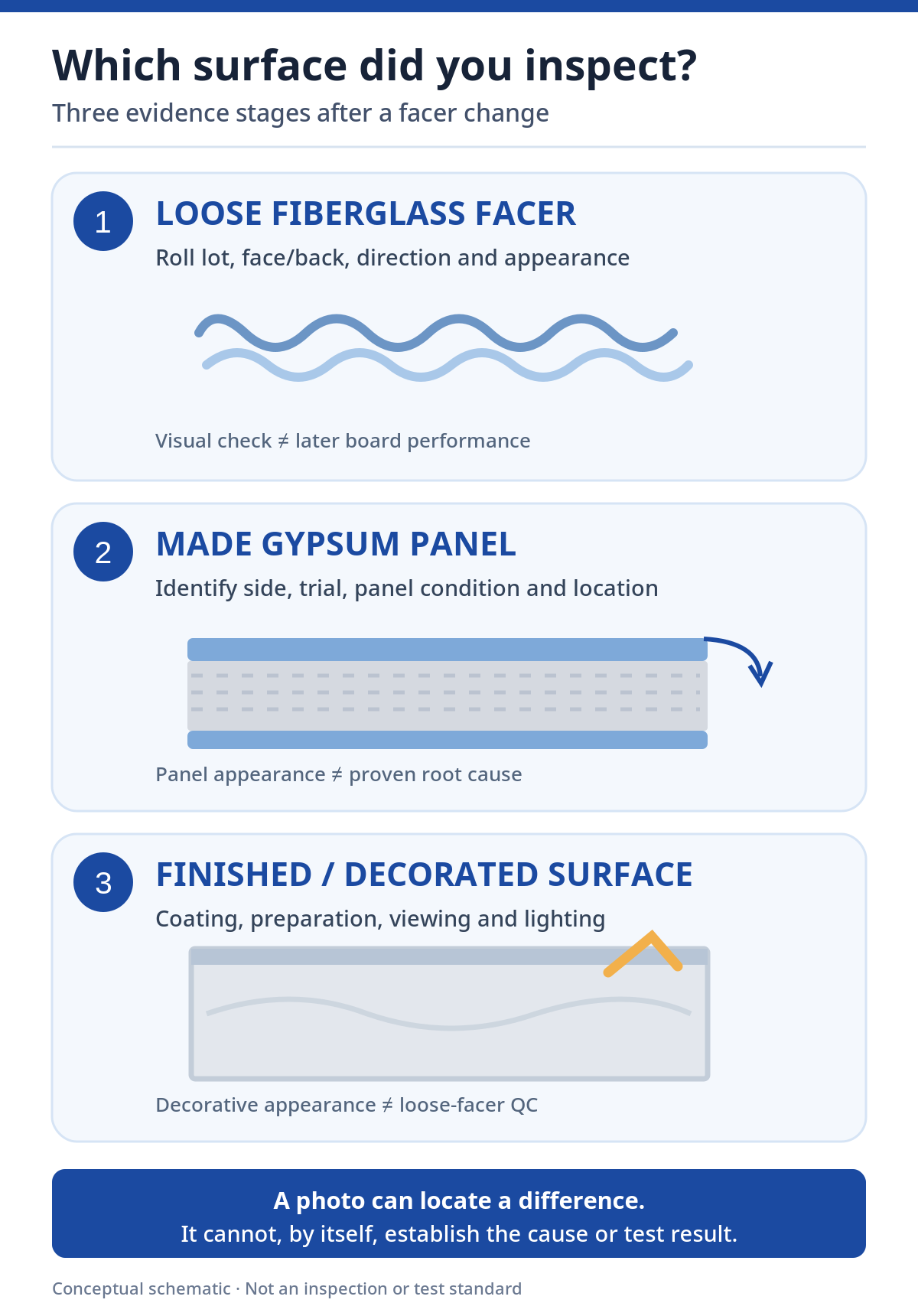
Buyer answer. A gypsum board can show a different surface after a glass-mat facer change without proving that the loose mat is defective, that the board-to-facer interface is weak, or that the decorated panel will perform differently. Visual inspection is useful for locating and recording a difference. It does not, by itself, identify the responsible material or replace a specified physical test. A useful review separates three stages: the incoming facer, the manufactured gypsum panel, and any subsequently finished or decorated surface.
This article is for gypsum-board manufacturers and their material partners assessing a change in glass-mat facing. It is not a finished-board acceptance standard, an installation specification or a claim that GRECHO operates a board factory or test laboratory.
1. Which surface was actually inspected?
The word surface is ambiguous in a report. A photograph of an unbonded glass mat, a newly formed panel and a painted wall may all be called a surface-inspection image, but each answers a different question. Even the same visible line or spot can have different plausible origins at different stages. State the stage before interpreting the photograph.
| Inspection stage | Useful observation | What it cannot establish alone |
|---|---|---|
| Incoming loose facer | Face/back identity, roll orientation, local appearance, visible streaks, handling marks or irregularities. | That the material will bond correctly to a particular gypsum formulation, or that a later board property will pass. |
| Made gypsum board | Which panel face shows a mark; its location, repeatability, apparent texture and relationship to a trial condition. | Whether the root cause is the mat, slurry contact, drying, other line conditions or handling. |
| Finished or decorated panel | Appearance under a stated coating, preparation, viewing distance and lighting condition. | Uncoated facer uniformity, board-to-core bond or a numerical physical property of the panel. |
ASTM C1658/C1658M describes several categories of glass-mat gypsum panels; its published scope concerns panel products, not a universal pass/fail inspection for a loose mat. The specific product type and applicable market specification must be established before a panel requirement is invoked. [1]
2. Make the visual comparison repeatable
Begin with a matched reference. Compare the candidate facer with the accepted reference under the same agreed conditions wherever practical. Label the production or laboratory sample before taking photographs. Retain the roll or batch ID, machine/cross direction where relevant, face/back side, panel formulation or trial identity, sampling position, process checkpoint, observation time and lighting arrangement. If only one of those facts is known, say so rather than retroactively filling the record.
Use two views where useful: an overview that locates the mark within the sheet or panel, and a close view with a scale or other size reference. The light source and camera exposure should be consistent enough for a meaningful side-by-side review. These are practical documentation suggestions, not a standardized lighting protocol or defect-acceptance limit.
Do not merge samples taken before and after drying, conditioning, primer application or transport into a single unlabeled comparison. If the face under review is on a two-sided construction, identify which side was inspected.
3. Translate an observation into a question, not an instant diagnosis
A line, patch, roughness change or local lift is a useful trigger for investigation. It is not proof of an inherent glass-fiber quality problem. The next evidence request should be chosen according to the observation and the manufacturing stage.
| What was observed? | Candidate explanations to investigate | Useful next evidence |
|---|---|---|
| Repeated streaks on a loose mat | Lot variation, roll path or handling; the cause is not established by the picture. | Matched roll positions, direction, both faces and incoming material records. |
| Uneven appearance after board formation | Mat appearance, slurry contact, process conditions or moisture-state differences. | Same-mat reference boards, actual line settings and comparable checkpoints. |
| Local lifting or apparent separation | Interface formation, specimen preparation, damage after manufacture or handling. | Defined bonded specimen, location and failure description; a suitable agreed bond assessment where needed. |
| Different appearance after paint | Surface preparation, coating, lighting, finish system and substrate texture. | Documented decoration system, primer/coat conditions and agreed finished-surface mock-up. |
| A changed water-test result | Panel composition, test side, method, condition or construction differences. | The specified panel test report, not a photograph or loose-mat assertion. |
This table is an editorial investigation aid. It is not a validated fault tree, a laboratory diagnostic method or a promise that any one follow-up test will identify the cause.
4. Separate appearance, bond evidence and water performance
Visual uniformity is not a synonym for facer-to-core adhesion. A surface may look consistent while a separate interface question remains unresolved; conversely, a visible mark need not imply a failed bond. If bond performance matters, agree on the specimen and method with the board manufacturer and qualified technical team. Record where any failure occurred. Do not invent a minimum bond value from a photograph or borrow a value from an unrelated material.
Water-related panel evidence is another distinct category. ASTM C473-24 publicly lists separate physical test methods for gypsum panel products, including water resistance of certain core-treated panels and surface water resistance of panels with water-repellent surfaces. Its test scope concerns panel specimens. A favorable surface appearance cannot substitute for either result, and neither is automatically a test of an unbonded facer. [2]
For the more detailed distinction between a board’s surface-water and total-water results, use GRECHO’s existing guide, Gypsum Board Facer Changes: Surface vs Total Water Absorption. That article retains ownership of the water-test comparison; this guide does not repeat the methods or claim thresholds.
5. Do not use a finished wall to diagnose a raw facer
A surface inspected after joint treatment, skim coating, primer or painting is no longer just the incoming facer. The Gypsum Association describes how the appearance of completed gypsum-panel surfaces depends on finishing, lighting and the decoration system; jobsite mock-ups help establish an expected appearance for the specified use. [4]
National Gypsum’s public guidance also warns that glass-mat and fiber-reinforced gypsum panels may need manufacturer-specific finishing recommendations. This is not evidence that every glass-mat product needs the same treatment. [5]
For that downstream question, consult the existing GRECHO explanation Why Do Gypsum Board Joints Show Through Paint?. Joint appearance under paint is a separate finished-system issue, not a stand-in for incoming mat QC or board-line acceptance.
6. What does a published panel standard actually cover?
Do not assume that the word inspection in the name of a standard supplies a universal visual-defect checklist. ASTM C1264-19(2024) addresses sampling, inspection, reporting and associated shipping/handling matters for gypsum panel products shipped from a manufacturer. Its public scope explicitly excludes storage or stocking at individual jobsites. Applicability, sampling and acceptance arrangements depend on the product and relevant purchase requirements. It does not prescribe a single inspection lighting setup for every loose glass veil. [3]
Similarly, ASTM C1658/C1658M-19(2024) describes different glass-mat gypsum panel categories, while ASTM C473-24 identifies panel physical test methods. They do not make the same claim about the same object. These North American references are used here to illustrate scope separation, not to declare one ASTM method the governing specification for a European gypsum-board line or a GRECHO facer.
When comparing European or other projects, ask the manufacturer to name the applicable product specification, market, intended application and agreed inspection criteria. The publication name alone is not evidence of conformity or a GRECHO certification.
7. A practical seven-field review record
Instead of asking whether a sample looks good, request seven linked fields for the specific observation: (1) sample and lot identity; (2) inspected physical object; (3) face and sampling location; (4) production and conditioning state; (5) lighting and photograph record; (6) defined observation or measured property; and (7) decision owner and next evidence needed. A single photograph should be attached to the correct record, not circulated as proof of all seven fields.
When a new facer is trialed, consider an unchanged reference panel from the same relevant production conditions. If materials, process settings and timepoints changed together, mark the comparison as confounded. Agree in advance whether the next question is visual appearance, interface integrity, water response or finished-surface performance. Each may require a different specimen and source of evidence.
Keep a neutral disposition such as observation confirmed; cause not established; additional data requested where evidence is insufficient. Do not convert an unresolved appearance note into an invented specification failure.
8. What should a board manufacturer send for a targeted facer review?
A useful inquiry starts with the board application and the stage at which the difference appeared. Include the actual facer direction, sample description, board type, desired outcome, same-condition reference, a few labeled photographs and the test or inspection report that prompted the question. If an external specification applies, identify it rather than paraphrasing a pass/fail threshold.
GRECHO can help organize an application-matched material and sample-documentation review, working with the manufacturing and technical parties responsible for validation. See our gypsum-board facer solution overview and technical resource center. For a specific trial or report comparison, request technical-data and sample-review support.
GRECHO does not present itself as a board manufacturer, accredited testing laboratory or certification body. Any final product performance or acceptance statement belongs to the responsible manufacturer and its supporting evidence.
Frequently asked questions
Does a visually uniform glass mat prove that a gypsum board will be acceptable?
No. Uniformity is an observation about the inspected sample and conditions. Board composition, interface behavior and applicable physical properties need their own evidence.
Can a photograph of a mark identify which production input caused it?
Not reliably on its own. Preserve location, time, process state and an appropriate control before attributing a mark to the loose facer, slurry contact or later handling.
Is surface water absorption the same as surface inspection?
No. A visual check records what is seen. Water-related panel evaluations have defined specimens and methods; the existing surface-versus-total absorption guide explains that distinction separately.
Should the same acceptance photograph be used for bare mat, board and paint?
No. Each stage changes what is being observed. Record the physical object and comparison conditions, and use a finished-system mock-up when the question concerns decoration.
What should be requested before changing a facer specification?
Identify the intended board, relevant side and function, observed issue, agreed test or inspection criterion, comparable reference specimen and responsible reviewer. If these are absent, request clarification rather than prescribing a new material grade or acceptance value.
References and scope
- ASTM C1658/C1658M-19(2024), Standard Specification for Glass Mat Gypsum Panels. Official public abstract and scope; no paid full-text methods consulted.
- ASTM C473-24, Standard Test Methods for Physical Testing of Gypsum Panel Products. Official public scope; not a loose-facer test or a universal requirement for all markets.
- ASTM C1264-19(2024), Sampling, Inspection and Related Requirements for Gypsum Panel Products. Official public scope; purchase-agreement and product-stage boundaries remain applicable.
- Gypsum Association, FAQ on finish levels and mock-ups. Guidance for finishing/decorated panel appearance, not incoming facer QC.
- National Gypsum, Gypsum Board Finish Levels. Manufacturer educational guidance; finished-wall context is not transferable to every facer.
Evidence note: No GRECHO product test result, yield, process recipe, defect limit, certification or customer inquiry has been inferred. The seven-field record and observation table are editorial aids, not industry standards. Source scopes were checked against public pages on 29 October 2026.
